A club is remembered through more than its playlist. It is remembered through the pressure of bass, the clarity of vocals, and the way light moves across the room. When sound and lighting respond together, a crowded venue can feel more intentional, immersive, and comfortable.
This raises an important question: why is acoustics-driven lighting design important for clubs? The answer begins with communication. Carefully measured sound levels can trigger lighting changes that support musical transitions without overwhelming guests. A warm wash may soften a quiet lounge area, while precise beams can reinforce a powerful drop on the dance floor. These choices help performers shape atmosphere and help visitors understand the room’s energy.
In real venues, the result depends on more than advanced equipment. Microphone placement, speaker direction, reflective surfaces, and lighting angles all influence the experience. Poor calibration can create harsh flashes, visual fatigue, or distracting movement. I have seen impressive systems feel disconnected when lighting reacted late or ignored the room’s acoustics. That weakness matters.
Good design also supports safety and operational control. Lighting should preserve clear walkways, visible exits, and comfortable viewing conditions. Experienced designers test systems with staff, performers, and different audience sizes before opening night. They measure response, observe reactions, and adjust conservatively.
Not every club needs dramatic effects. Sometimes, restraint works better. A quieter transition can make the next musical moment feel larger. This approach is not perfect, because every audience responds differently. Yet acoustic-led lighting offers a practical framework for creating memorable spaces without sacrificing comfort, reliability, or professional control.
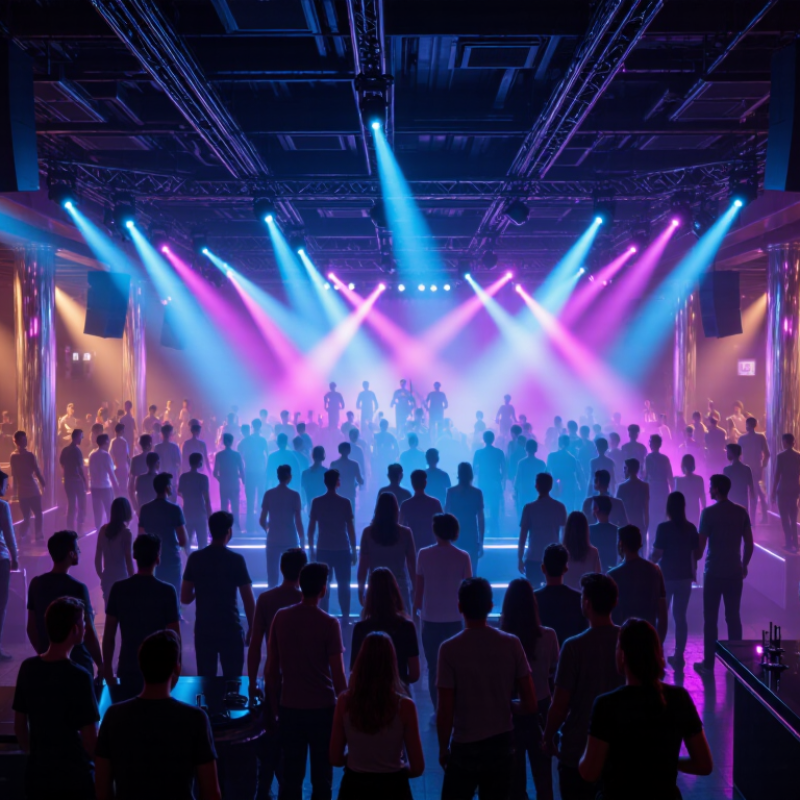
Acoustics-driven lighting connects a club’s sound system with its lighting control network. Microphones or digital audio feeds analyze kick drums, bass, vocals, and sudden transients. Software then converts these signals into brightness, color, movement, and timing changes. A kick can trigger a short floor-level flash, while sustained vocals may create a slower ceiling wash.
Timing matters more than spectacle. Even a small delay can make the room feel disconnected. In practice, technicians adjust latency, microphone placement, and frequency thresholds during live sound checks. Reflections from concrete walls can also distort the audio signal. That makes calibration necessary.
The World Health Organization’s 2022 Global Standard for Safe Listening Venues recommends limiting average exposure to 100 dB LAeq,15min. Lighting should support the music without encouraging unsafe volume levels. Lower-frequency energy can control subtle brightness changes, reducing the need for constant intense flashes. CIE 150:2017 also highlights glare and unwanted light spill as important environmental concerns. Poorly aimed fixtures may distract performers and reduce visual comfort.
It is not perfect.
Crowd movement changes the room’s acoustic response. A lighting scene that works during an empty sound check may feel too sharp when hundreds of people enter. Experienced operators keep manual control available and review audience reactions throughout the night. Sometimes, restraint creates stronger impact than maximum brightness.
Why Is Acoustics Driven Lighting Important for Clubs?
Key Technologies Behind Sound-Responsive Club Lighting
Sound-responsive lighting depends on more than flashing fixtures. It begins with clean audio analysis. A digital signal processor separates bass, rhythm, and vocal frequencies in real time. Beat detection then converts these elements into lighting cues. Fast Fourier Transform analysis can identify frequency energy across the spectrum. This allows low frequencies to control ceiling washes while percussion triggers sharper beams. Timing matters. A practical system should keep audio-to-light latency below 20 milliseconds. Even small delays can make movement feel disconnected.
DMX or Art-Net distributes these cues across lighting fixtures. Sensors can also monitor room sound pressure, reducing excessive brightness during quieter sections. NIOSH’s Criteria for a Recommended Standard: Occupational Noise Exposure identifies 85 dBA over eight hours as a recommended exposure limit. Club operators should treat sound and visual intensity as connected comfort issues. Automatic dimming and fixture zoning can protect sightlines near the dance floor. It also saves energy. The U.S. Department of Energy reports that LED lighting generally uses at least 75% less energy than incandescent lighting.
Real venues remain imperfect. Reflections, crowded rooms, and uneven speaker coverage can confuse microphones. A calibration test at several floor positions is essential. Sometimes a manually designed cue feels better than an algorithm. That limitation deserves attention. Good programming combines measured audio data with human judgment, rather than trusting automation completely.
Acoustics-driven lighting turns sound into visible movement. A bass pulse can deepen blue tones, while a vocal break can soften the room. This connection makes the atmosphere feel responsive, not merely programmed. Lighting also influences perceived energy, attention, and movement in entertainment spaces. However, excessive flashing can cause fatigue. More intensity does not always create more excitement.
Energy efficiency matters during long club operations. The International Energy Agency reports that lighting uses about 15% of global electricity and creates roughly 5% of global greenhouse gas emissions. The U.S. Department of Energy states that LED systems use at least 75% less energy than incandescent lighting and can last up to 25 times longer. A sound-responsive LED system can reduce unnecessary output during quieter moments. It can also dim unused zones automatically. These savings depend on proper calibration, maintenance, and realistic programming.
Tips: Set different lighting responses for bass, vocals, and ambient sound. Keep pathways calmer and dance areas more dynamic. Test scenes with staff before opening. The system will not always read the room correctly. Human judgment still matters. Track energy use and audience reactions monthly. A 2023 report from the International Association of Amusement Parks and Attractions highlights personalized, sensory experiences as important to visitor satisfaction. Clubs should treat audience response as evidence, not assumption.
Acoustics-driven lighting can make a club feel alive, but safety must guide the spectacle. The system should translate rhythm into gentle changes in brightness, colour, and movement. It should not simply flash with every beat. WHO’s World Report on Hearing (2021) estimates that over 1 billion young people face a risk of hearing loss from recreational noise. NIOSH recommends limiting exposure to 85 dBA over eight hours, using a 3 dB exchange rate. Lighting designers should therefore coordinate sound pressure, occupancy, and visual intensity.
A balanced system needs clear escape routes, stable low-level illumination, and controlled contrast near stairs. CIE 150:2017 provides useful guidance for limiting obtrusive light, while IEEE 1789-2015 offers a framework for reducing health risks from LED flicker. These standards do not replace site testing. They support it. In practice, measure brightness at eye level and check the room from the dance floor, bar, and exit path. A design may look impressive in software, yet feel harsh after two hours. That uncomfortable finding matters.
Tips:
Why Is Acoustics Driven Lighting Important for Clubs?
Acoustics driven lighting can make a club feel physically connected to its music. Lights respond to rhythm, bass, and vocal changes, creating movement across the room. However, choosing the right system requires more than bright colors and fast effects. The venue’s acoustics matter. Hard walls may create sharp reflections, while soft surfaces can reduce the system’s response. Test lighting with real sound levels before installation. A delayed lighting reaction can quickly weaken the experience.
Consider response speed, brightness control, beam angle, color accuracy, and operating noise. Fixtures should support the club’s layout, not block sightlines or overwhelm smaller areas. Warm tones can make lounge spaces comfortable, while cooler tones may sharpen energetic dance areas. Check heat output and electrical safety carefully. Emergency lighting must remain clear and independent. Reliable controls also matter, especially during crowded events and long operating hours. A beautiful system that needs constant resetting is not a practical solution.
Tips: Use several lighting zones instead of one powerful source. Match effects to the room’s acoustic behavior. Keep brightness adjustable. Test from the dance floor, bar, and entrance. Watch for glare on polished surfaces. Leave room for quieter scenes. More movement is not always better. In practice, a slightly imperfect response can feel more natural than a perfectly timed but exhausting display.
| Evaluation Dimension | Practical Data or Benchmark | Why It Matters in a Club | Selection and Verification Points |
|---|---|---|---|
| Acoustic compatibility | Choose luminaires with passive cooling, low mechanical noise, and no audible buzzing during dimming or color changes. | Fans, vibrating parts, and poorly controlled drivers can add distracting noise to quiet areas, lounges, and transition zones. | Test fixtures at maximum output, minimum dimming level, and every operating mode in the actual room. |
| Sound-pressure environment | Busy dance floors may regularly experience sound levels around 95–105 dBA, depending on venue design and operating practice. | High sound levels can mask fixture noise and increase the importance of reliable, vibration-resistant lighting hardware. | Use independent sound-level monitoring, secure all fixtures, and prevent rattling from housings, brackets, and acoustic panels. |
| Illuminance by zone | Typical planning ranges: 100–300 lux for circulation and service areas, 50–150 lux for relaxed lounge areas, and highly dynamic levels for dance floors. | Different zones need different visual comfort levels; excessive brightness can reduce atmosphere and increase glare. | Measure horizontal and vertical illuminance after installation and include dimming scenes for entrance, service, performance, and cleaning. |
| Color rendering | A CRI of 80 or higher is a common baseline; CRI 90 or higher is preferable for bars, hospitality areas, skin tones, and photography. | Accurate color improves drink presentation, staff visibility, wayfinding, and the appearance of people in social spaces. | Review the full color-quality specification, including R9 performance where red tones are important. |
| Color temperature | Warm white around 2700–3000 K often supports lounge comfort; 3000–4000 K can improve task visibility in service and circulation areas. | Color temperature influences perceived mood, facial appearance, spatial definition, and the visual separation of club zones. | Use tunable white or separate scenes where the venue changes from dining and social use to energetic events. |
| Flicker and stroboscopic effects | Low-flicker operation is especially important during dimming, video recording, and movement-heavy performances. | Flicker can cause visual discomfort and may appear as banding or rolling patterns in cameras and smartphones. | Request flicker test data across the complete dimming range rather than relying only on a nominal flicker percentage. |
| Dimming and control response | Smooth control from approximately 1% to 100% output is desirable for layered scenes, subject to the fixture and control protocol. | Precise transitions allow lighting to follow music, performances, announcements, and safety procedures without abrupt visual changes. | Check fade curves, minimum stable output, latency, control compatibility, and recovery after power interruption. |
| Energy efficiency and heat | Modern LED fixtures commonly provide roughly 80–150 lumens per watt, depending on optics, color quality, and operating conditions. | Lower electrical demand reduces operating costs and limits heat added to crowded interiors, which can support HVAC performance. | Compare delivered lumens per watt, not just LED chip efficiency, and review thermal performance at continuous output. |
| Beam angle and glare | Narrow beams concentrate effects; medium and wide beams provide broader coverage with fewer overlapping hotspots. | Incorrect optics can create glare for guests, performers, bartenders, and security staff while leaving other areas underlit. | Review photometric files, shielding angles, mounting height, aiming positions, and sightlines from seated and standing locations. |
| Moisture and dust protection | IP ratings indicate protection against solids and water; IP65, for example, is dust-tight and protected against water jets. | Bars, outdoor terraces, fog effects, cleaning procedures, and condensation can expose equipment to moisture and contaminants. | Select the rating for the actual location and verify cable glands, connectors, drainage, and installation orientation. |
| Mechanical safety | Fixtures installed overhead require suitable load calculations, primary fixings, secondary safety retention, and periodic inspection. | Vibration from loud music, moving equipment, and dense crowds can increase the consequences of loose hardware. | Follow local building and electrical requirements, document inspections, and use qualified installers. |
| Maintenance and service life | LED systems often have rated lifetimes of 50,000 hours or more, but actual life depends on temperature, drive current, and maintenance. | Long service intervals reduce downtime, lift access, labor costs, and disruption to scheduled events. | Check lumen-maintenance data, driver replacement access, cleaning requirements, spare-part availability, and warranty terms. |
| Emergency and operational control | Emergency lighting must remain independent and compliant with applicable local regulations; decorative scenes should not obstruct exits or safety signs. | A club requires both atmosphere and reliable evacuation visibility during power loss, incidents, and staff response. | Separate decorative and life-safety systems, provide manual override access, and test emergency operation on a documented schedule. |
Note: The numerical ranges are practical planning references rather than universal requirements. Final lighting, acoustic, electrical, fire, and emergency-lighting decisions should be verified against the venue layout and applicable local regulations.
Microphones or audio feeds analyze bass, vocals, kicks, and sudden sounds. Software converts them into brightness, color, movement, and timing. A kick may create a brief floor flash.
Delayed lighting can make music and visuals feel disconnected. Technicians adjust latency during live sound checks. Small delays matter.
Technicians adjust microphone positions, frequency thresholds, and response speeds. Concrete walls may reflect sound and distort readings. Calibration must happen inside the actual room.
Yes, because visible changes follow the music. Bass may deepen blue tones, while vocals can soften the ceiling glow. The room feels more responsive.
Yes. Constant flashes may cause fatigue and visual stress. Bright fixtures can distract performers. More intensity does not always create more excitement.
LED fixtures can dim quiet zones and reduce unnecessary output. Different areas can follow different sound levels. Savings depend on programming and maintenance.
No. Bass, vocals, and ambient sound need separate responses. Dance areas can move dynamically, while pathways should remain calmer. Balance matters.
People change the room’s acoustic response. An empty-room setting may feel too sharp later. Operators should watch reactions and adjust manually.
Staff should test scenes before opening. Check timing, glare, pathways, and floor-level flashes. Review audience reactions during the night.
No. The system may misread noise or room changes. Human judgment remains necessary. Sometimes restraint creates stronger impact.
Acoustics-driven lighting transforms a nightclub’s sound into dynamic visual movement, allowing lighting to respond to rhythm, volume, and musical transitions in real time. This approach combines microphones, audio processors, control software, LED fixtures, and programmable effects to create synchronized scenes without relying only on manual operation. Understanding why is acoustics-driven lighting design important for clubs helps explain how it can strengthen the connection between music, space, and audience experience.
A well-designed system can build energy, highlight key moments, improve audience engagement, and support more efficient energy use by adjusting intensity and activity when needed. However, effective design requires balance. Lighting should remain comfortable, avoid excessive glare or disorientation, and maintain clear pathways, exits, and staff visibility. When selecting a solution, club operators should consider sound sensitivity, response speed, fixture quality, control flexibility, maintenance needs, room layout, energy consumption, and safety features. The best systems enhance the atmosphere while remaining reliable, adaptable, and comfortable for everyone in the venue.

Sienna Lights