Top 10 Most Durable Materials for Commercial Luxury Lighting?

Time:2026-10-20 Author:Isabella
0%

Commercial luxury lighting must survive more than visual trends. It faces heat, vibration, cleaning chemicals, fingerprints, and repeated servicing. The U.S. Department of Energy reports that quality LED systems can deliver approximately 25,000 to 50,000 hours of useful life. Yet the fixture’s housing, diffuser, finish, and fasteners often determine whether that promise survives in practice.

That is why this guide asks: what materials are most durable for commercial luxury lighting? It examines brass, stainless steel, aluminum, bronze, glass, crystal, engineered stone, ceramic, and selected polymers. Each material responds differently to moisture, impact, thermal cycling, and surface abrasion. IEA energy-efficiency reports continue to emphasize lighting’s significant electricity demand worldwide, making reliable performance increasingly important for commercial operators. Durability is not only a design preference. It affects maintenance costs, downtime, replacement waste, and the customer experience beneath the fixture.

Real projects reveal the complications. A brass pendant may develop a desirable patina, while a coastal hotel may need sealed stainless steel instead. Tempered glass can remain elegant after years of cleaning, but poor edge protection may still cause failure. UL 1598, IES LM-80, and TM-21 testing provide useful performance evidence, although they cannot replace site-specific judgment. No material wins every project. That assumption deserves testing. This ranking combines material science, manufacturer specifications, hospitality installation experience, and published industry guidance to identify where luxury appearance and long service life genuinely meet.
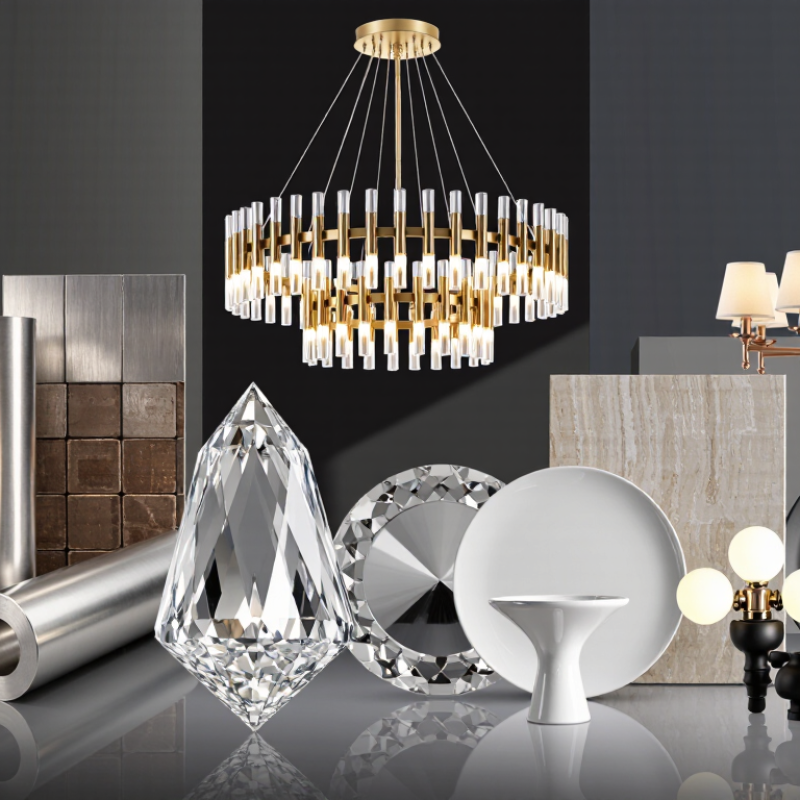
Top 10 Most Durable Materials for Commercial Luxury Lighting?

Durability Metrics: IEC 60529 IP Ratings, IK Impact, and ASTM Testing

Commercial luxury lighting needs more than visual polish. The strongest material choices include 316 stainless steel, anodized aluminum, brass, bronze, copper, tempered glass, borosilicate glass, polycarbonate, ceramic, and engineered stone. Each responds differently to moisture, impact, heat, and cleaning chemicals. Material selection should follow measured exposure, not showroom appearance.

IEC 60529 gives IP ratings for dust and water protection. IP65 means dust-tight protection and resistance to water jets. IP67 adds temporary immersion protection. These ratings describe the enclosure, not every joint, coating, or cable entry. IEC 62262 rates impact resistance from IK01 to IK10. IK08 withstands 5 joules, while IK10 withstands 20 joules. That difference matters near entrances, restaurants, and public corridors.

ASTM testing adds useful evidence. ASTM B117 salt-spray testing compares corrosion resistance, but it does not predict exact outdoor service life. ASTM G154 helps evaluate ultraviolet exposure for polymers and finishes. ASTM D256 can measure plastic impact strength, although fixture geometry still changes real performance. Industry testing reports repeatedly warn against treating laboratory hours as guaranteed years. A lab pass is not a promise. In practice, I would specify sealed aluminum or stainless steel for humid zones, laminated or tempered glass near people, and stabilized polycarbonate where repeated impact is likely. Even then, maintenance remains the weak point. A damaged gasket can quietly defeat an excellent IP rating.

Metals 1–4: 316 Stainless Steel, 6061-T6 Aluminum, Brass, and Copper

Top 10 Most Durable Materials for Commercial Luxury Lighting

Metals 1–4: 316 Stainless Steel, 6061-T6 Aluminum, Brass, and Copper

316 stainless steel suits luxury fixtures exposed to humidity, fingerprints, and cleaning routines. ASTM A240 data lists approximately 16–18% chromium and 2–3% molybdenum. That composition improves resistance to pitting. However, it can still stain near saltwater without proper cleaning. Industry stainless data also shows recycling remains a major material advantage, with recycled content commonly supporting lower production impact.

6061-T6 aluminum offers a practical strength-to-weight balance. The Aluminum Association lists a minimum tensile strength near 310 MPa for this temper. It reduces mounting loads and supports large suspended forms. Its oxide layer protects the surface, but scratches can expose unfinished areas. Brass adds warmth, weight, and visual depth. Copper develops a living patina and provides excellent thermal conductivity, near 401 W/m·K at room temperature, according to Copper Development Association technical data. These qualities can improve heat management around LED components, though thermal design still needs testing. I have seen beautiful copper fixtures age unevenly. That is not always a flaw, but it needs approval.

Tips: Match the metal to humidity, salt exposure, touch frequency, and fixture weight. Specify brushed finishes where fingerprints matter. Use compatible fasteners to reduce galvanic corrosion. Test samples under real cleaning conditions. Surface coating choices deserve more attention than many specifications allow.

Glass and Ceramics 5–7: Borosilicate Glass at 820°C and Porcelain

Borosilicate glass earns its place among durable luxury-lighting materials through thermal stability, not appearance alone. Commercial formulations often show softening points near 820°C, while their low expansion coefficient approaches 3.3 × 10⁻⁶/K. That matters when a pendant warms beside a high-output LED module and cools after shutdown. The U.S. Department of Energy’s 2022 Solid-State Lighting R&D Opportunities report identifies thermal management as a continuing reliability concern. In practice, borosilicate shades tolerate temperature changes better than ordinary soda-lime glass. Still, they are not impact-proof. A sharp edge or hidden mounting stress can defeat excellent heat resistance.

Porcelain offers a different kind of endurance. Ceramic-industry technical literature commonly places porcelain firing between 1200°C and 1400°C, creating a dense, low-porosity body. Its surface resists scratching, staining, and ultraviolet discoloration, which suits hotel lobbies and frequently cleaned public interiors. The European Commission’s lighting-product studies also emphasize material durability and maintenance as part of whole-life performance. Porcelain can support this goal, but its rigidity demands careful engineering around screws, sockets, and suspension points.

Small details matter.

I have seen beautiful ceramic fixtures develop hairline cracks near poorly isolated metal fittings. That failure is easy to blame on the material, yet the joint often causes it. ASTM C372 testing for thermal expansion and ISO 10545-3 water absorption methods can improve specification discipline. Designers should still request batch data, edge inspection, and thermal-cycle testing. A reported 820°C softening point is useful, but it does not replace real fixture testing.

Top 10 Most Durable Materials for Commercial Luxury Lighting — Glass and Ceramics 5–7: Borosilicate Glass at 820°C and Porcelain
Rank Material Key Thermal Data Durability Characteristics Suitable Commercial Lighting Uses Practical Durability Assessment
5 Borosilicate Glass Softening point: approximately 820°C
Coefficient of thermal expansion: about 3.3 × 10⁻⁶/K
Excellent thermal-shock resistance, high chemical resistance, and low expansion compared with ordinary soda-lime glass. Pendant shades, enclosed diffuser tubes, high-temperature decorative elements, and luminaires exposed to frequent temperature changes. Highly durable for demanding lighting environments when protected from sharp impact and edge damage. Its low thermal expansion helps reduce cracking during heating and cooling cycles.
6 Porcelain Typical vitrification or firing range: approximately 1,200–1,400°C
Water absorption after vitrification: commonly below 0.5%
Hard, electrically insulating, UV-stable, stain-resistant, and highly resistant to moisture when fully vitrified and properly glazed. Ceramic lamp bodies, wall sconces, ceiling fixtures, socket surrounds, and luxury decorative housings. Excellent long-term resistance to humidity, discoloration, and surface wear. It is comparatively brittle and can chip or fracture under severe impact or concentrated mechanical stress.
7 Alumina Ceramic Melting point: approximately 2,050–2,070°C
Typical continuous-use capability: commonly above 1,000°C, depending on grade and design
Very high hardness, strong electrical insulation, excellent wear resistance, and strong resistance to oxidation and chemical attack. High-temperature lamp components, insulating supports, precision reflectors, industrial-luxury fixtures, and mechanically demanding internal parts. One of the most robust ceramic choices for heat and wear resistance. Its main limitations are brittleness, higher manufacturing cost, and the need for careful control of mounting stress.
Typical published material values are shown for comparison. Actual performance depends on composition, grade, wall thickness, surface finish, mounting method, thermal cycling, and exposure to impact or chemicals.

Polymers 8–10: PMMA at 92% Transmittance, Polycarbonate, and PTFE

PMMA can reach about 92% light transmittance in clear grades. The exact figure depends on thickness, wavelength, surface finish, and testing method. Its crisp clarity suits glowing pendants and slim edge-lit panels. It also resists weathering better than many transparent plastics. However, PMMA can crack around poorly drilled holes. I have seen small installation stresses become visible fractures months later.

Polycarbonate offers stronger impact resistance. It is useful in public spaces, hotels, and large suspended fixtures where maintenance tools may strike the diffuser. Its toughness is impressive. Yet, heat and ultraviolet exposure can cause yellowing without suitable protection. Designers should check the operating temperature near LEDs, drivers, and enclosed cavities. A clear sample may look excellent in a showroom, then age differently under real heat cycles.

PTFE serves a different purpose. It tolerates chemicals, heat, and harsh cleaning conditions. Its white, highly diffuse surface can soften intense LED points and reduce glare. Optical performance varies widely by formulation and thickness, so “PTFE” alone is not a sufficient specification. It may also reduce sparkle compared with clear PMMA. That trade-off deserves a physical mock-up, not just a datasheet review. Small details matter: edge support, cleaning methods, fastener pressure, and thermal expansion can decide whether a luxury fixture stays refined. Testing often exposes assumptions.

Commercial Selection: 50,000-Hour LED Life, Corrosion, Heat, and Load Data

Top 10 Most Durable Materials for Commercial Luxury Lighting?

Commercial luxury lighting must survive heat, cleaning, vibration, and humid air. Material choice should follow tested performance, not showroom appearance.

The strongest shortlist includes marine-grade stainless steel, anodized aluminum, brass, copper, zinc alloy, tempered glass, borosilicate glass, polycarbonate, acrylic, and technical ceramic. Stainless steel resists corrosion in demanding interiors, while anodized aluminum combines low weight with stable heat dissipation. Brass and copper age attractively, but their surfaces need controlled finishing. Tempered glass handles impact better than ordinary glass. Polycarbonate tolerates shocks, although ultraviolet exposure can reduce clarity.

The details matter more than the material name. The U.S. Department of Energy reports that quality LED systems commonly target 50,000 hours of useful life, but this is not a guaranteed operating period. IES LM-80 and TM-21 methods evaluate LED lumen maintenance and projection behavior. Heat remains critical. A poorly ventilated housing can shorten driver and LED life, even with premium materials. IEC 60598-1 provides safety requirements for temperature, wiring, insulation, and mechanical construction.

Corrosion testing should reference ISO 9223 classifications and controlled salt-spray methods such as ASTM B117. These tests help compare finishes, but they do not perfectly reproduce coastal air or chemical cleaning. Load checks also need real installation data, including ceiling vibration, fixture weight, and fastening strength. That assumption is often missed. In practice, the most durable specification combines metal thickness, protective coating, thermal design, and verified test records. Some “luxury” finishes still fail early when maintenance schedules are unrealistic.

FAQS

Why is borosilicate glass suitable near powerful LED modules?

Its softening point can approach 820°C. Its low expansion is about 3.3 × 10⁻⁶/K. This helps during repeated heating and cooling. It is still vulnerable to impact and mounting stress.

Is borosilicate glass unbreakable?

No. A sharp edge or hidden stress can cause failure. Heat resistance does not protect against dropped tools. Inspect edges and mounting points carefully. Not always obvious.

Why choose porcelain for public interiors?

Porcelain is fired between 1200°C and 1400°C. Its dense body has low porosity. It resists scratches, stains, and ultraviolet discoloration. This suits hotel lobbies and frequently cleaned spaces.

What risk does porcelain create around fittings?

Its rigidity can transfer stress to screws, sockets, and suspension points. Hairline cracks may form near poorly isolated metal fittings. The joint may be the problem, not the ceramic. Small details matter.

What should be checked before approving glass or porcelain fixtures?

Request batch data, edge inspection, and thermal-cycle testing. A published temperature rating is not enough. Test the complete fixture. Real assemblies can behave differently. I would not rely on numbers alone.

When is PMMA useful in decorative lighting?

Clear grades may transmit about 92% of light. It gives crisp clarity for pendants and edge-lit panels. Results vary with thickness, wavelength, finish, and testing method. Poorly drilled holes can become crack sources.

How does polycarbonate compare with PMMA?

Polycarbonate generally offers higher impact resistance. It suits public areas and large suspended diffusers. Heat and ultraviolet exposure may cause yellowing. Check conditions near LEDs, drivers, and enclosed cavities.

When should PTFE be considered?

PTFE tolerates chemicals, heat, and demanding cleaning. Its white diffuse surface can soften harsh LED points. It may reduce sparkle compared with clear PMMA. A physical mock-up is better than relying only on data.

Why are physical mock-ups important for polymer fixtures?

Optical performance changes with thickness, surface finish, and formulation. Cleaning pressure can also reveal weak edges or fasteners. A showroom sample may age differently under real heat cycles. Testing exposes assumptions.

Conclusion

Choosing the right materials is essential for commercial luxury lighting, where appearance must be supported by long-term performance. The question “what materials are most durable for commercial luxury lighting” can be answered by evaluating corrosion resistance, impact strength, heat tolerance, load capacity, and maintenance needs. IEC 60529 IP ratings help measure protection against dust and moisture, while IK impact classifications and ASTM testing provide additional evidence of mechanical durability.

The most dependable options include 316 stainless steel, 6061-T6 aluminum, brass, and copper for structural and decorative components. Borosilicate glass, capable of tolerating temperatures around 820°C, and porcelain offer strong thermal and surface stability. For lightweight optical and protective parts, PMMA provides up to 92% transmittance, while polycarbonate delivers excellent impact resistance and PTFE performs well in demanding chemical and thermal environments. Final selection should also consider corrosion exposure, operating heat, installation loads, and LED systems designed for approximately 50,000 hours of service.

Isabella

Isabella

Isabella is a dedicated marketing professional with a sharp focus on driving brand growth and engagement through strategic content creation. With an extensive background in digital marketing, she combines her passion for storytelling with her keen understanding of industry trends to deliver......